Sleep is not just sleep. It is a natural cycle directly connected to the sun, daylight, and night. It is a process that safeguards our physical, emotional, and cognitive well-being. Yet in today’s fast-paced world and under the constant pull of modern technology, we often fail to notice how much we interfere with this natural process — and in doing so, we harm ourselves. Disturbing sleep is no different than disturbing nature itself.
When we cut down trees and plants, the consequences are obvious — pollution, breathing difficulties, and climate imbalance. But when we disrupt our natural sleep cycle, the consequences also appear, though they are less visible and more individual: sometimes in the form of physical illness, sometimes as psychological struggles.
This article explores what sleep really is and how deeply it is connected with nature. It also shows why the timing of sleep — the hour you go to bed — is just as important as the quantity of sleep you get.
Let’s get deeper.
The Four Pillars of Sleep Regulation
To fully understand the sleep process, one must first understand the four most important sources of sleep regulation:
- Circadian rhythm
- Adenosine (sleep pressure)
- NREM sleep
- REM sleep
These four are not isolated; they are deeply interconnected, weaving together to form the natural architecture of human sleep.
Quick Roadmap (What You’ll Learn)
What the circadian rhythm is and why evolution tuned it to sunlight.
What adenosine (sleep pressure) does and how it’s cleared.
What NREM and REM sleep are, and how they cycle through the night.
How circadian timing and adenosine coordinate NREM/REM (the two-process model).
Concrete examples:
- 9 pm–4 am vs 2 am–9 am (same total hours, different quality).
- 2–3 hours/night (very short sleep).
- 9 pm–9 am (very long sleep).
Psychological and physical consequences of missing REM, missing NREM, or extreme sleep restriction/oversleeping.
Practical takeaways for protecting sleep.
Circadian Rhythm — the Body’s 24-Hour Conductor
What it is: Your circadian rhythm is an internal ~24-hour clock that times sleep/wake cycles, hormones, body temperature, metabolism, alertness, and countless cellular processes. The master clock sits in the suprachiasmatic nucleus (SCN) of the hypothalamus and is strongly influenced by light entering the eyes.
Why it evolved with the sun: For most of human history, there was no artificial light. Daylight reliably signaled activity (foraging, socialising, hunting), while darkness signaled safety in rest and energy conservation. Natural selection favoured physiology that aligned with this pattern: wakeful, alert days followed by quiet, reparative nights.
Key biological signals:
- Morning light (especially blue wavelengths): SCN suppresses melatonin and raises cortisol → increased wakefulness and alertness.
- Evening/darkness: Melatonin rises, core body temperature drops → increased sleepiness.
The result is that your brain expects a typical pattern: sleep beginning at night and waking with the morning sun. When you shift this pattern — for example, by staying up very late — the circadian clock becomes misaligned with both the external world and your internal systems (like hunger, hormones, metabolism). The outcome is fatigue, mood changes, and even metabolic disturbances.
Adenosine and Sleep Pressure (Process S)
What adenosine is: Adenosine is a chemical that builds up in the brain during wakefulness as a by-product of energy use. The more hours you stay awake, the more adenosine accumulates.
What it does: It promotes sleepiness by binding to brain receptors, making it easier to fall asleep and enter deep slow-wave sleep (SWS).
How it’s cleared: Deep NREM sleep (especially slow-wave sleep) helps clear adenosine and restore the brain. That’s why after long wakefulness you fall quickly into deep sleep, and why this stage feels so restorative.
Caffeine: Caffeine temporarily blocks adenosine receptors, reducing sleepiness without actually clearing the adenosine load. This is why caffeine delays sleep onset and can reduce deep sleep if consumed too late in the day.
NREM vs REM — Two Very Different Jobs
NREM (Non-Rapid Eye Movement Sleep)
- Divided into N1, N2, and N3 (with N3 = slow-wave or deep sleep).
- Functions: physical restoration (tissue repair, immune support), energy recovery, metabolic waste clearance (glymphatic activity), and consolidation of declarative memories (facts, events).
- Timing: Concentrated in the early part of the night.
REM (Rapid Eye Movement Sleep)
- Functions: vivid dreaming, emotional processing and regulation, creativity, procedural memory consolidation (skills), and neural plasticity.
- Timing: Dominates the late night and early morning.
Cycle Length
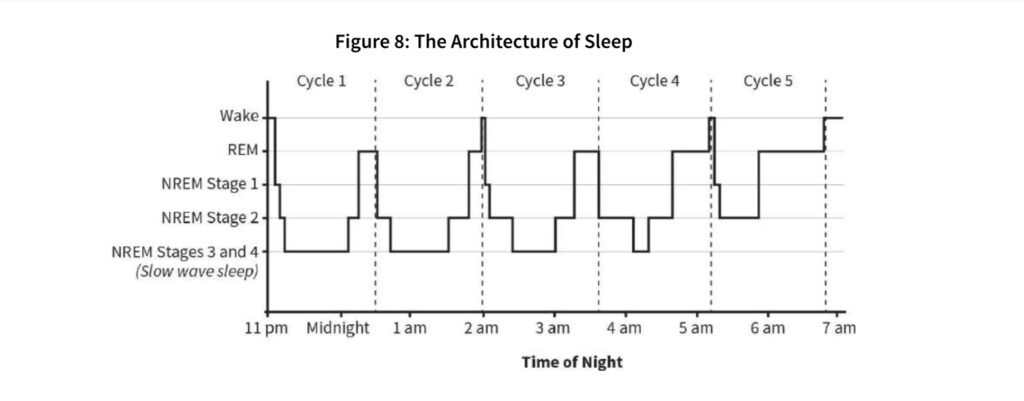
Sleep alternates between NREM and REM roughly every 90 minutes. Across a normal night, you experience multiple cycles, with more deep NREM earlier and longer REM periods later.
The Two-Process Model: How Circadian Rhythm and Adenosine Work Together
Two complementary forces determine when and how you sleep:
- Process S (homeostatic drive): Driven by adenosine. Builds with time awake, reduced by deep NREM sleep.
- Process C (circadian rhythm): The rhythmic drive from the SCN that gates alertness and sleepiness across the 24-hour day.
Together, they coordinate sleep timing:
- High adenosine makes you sleepy at night.
- Circadian signals open the “sleep gate,” favoring deep NREM earlier in the night and REM later.
- This ensures balance — physical restoration first, emotional and cognitive restoration later.
When either process is disturbed (by shift work, light exposure at night, caffeine, or sleep loss), the balance shifts. This alters the proportions of NREM and REM and, in turn, affects mood, cognition, and health.
NREM and Adenosine: The Jar Analogy
Imagine your mind as an empty jar. Throughout the day, this jar slowly fills up with tokens — each token representing the physical or mental effort you put in. The more you work, think, or engage, the more tokens collect in the jar. In scientific terms, these tokens represent the build-up of adenosine in the brain, which creates the feeling of exhaustion and the need for sleep.
At night, especially between 9 pm and 2 am, the brain begins to empty this jar. This process happens through deep NREM sleep, particularly Stage 4 slow-wave sleep, which is the most restorative form of sleep. What makes this period so effective is that it coincides with the body’s natural circadian rhythm.
During this early part of the night, nature’s sleep cycle works in your favour:
- Melatonin levels are high because of darkness, signaling the brain to prepare for deep rest.
- Core body temperature drops, creating ideal conditions for slow-wave activity.
- Cortisol (the alertness hormone) is at its lowest point, allowing the body to stay in deep sleep without interruptions.
- The overall dark environment reinforces the circadian rhythm’s message that this is the prime time for restoration.
Because of this alignment between adenosine pressure and circadian signals, the brain is able to clear adenosine most effectively during this window. In other words, there is no better time for deep NREM sleep than between 9 pm and 2 am, when both biology and nature are perfectly synchronized.
REM and Circadian Rhythm: The Brain’s Night Shift
There are stages of sleep where you may not enter deep sleep but instead experience dreams. This state is called REM sleep (Rapid Eye Movement sleep). Unlike NREM, REM serves a different but equally vital purpose — it helps to strengthen and integrate neural connections. In simple terms, REM is the stage where the brain works on emotional balance, creativity, problem-solving, and memory integration.
The process of REM builds upon what NREM has already done. During NREM, especially deep slow-wave sleep, the brain clears adenosine and restores the body. Once that physical restoration is underway, REM takes over to handle the mental and emotional restoration — sorting memories, stabilizing learning, and regulating mood.
Because REM is strongly connected with the circadian rhythm, its cycles grow longer and more intense as the night progresses. This is why dreams often feel more vivid in the early morning hours. By the time it is close to morning, usually between 2 am and 6 am, REM becomes the dominant stage of sleep. In this window, the circadian rhythm actively favors REM, allowing the brain to complete the cycle of restoration that NREM began earlier in the night.
In other words, NREM prepares the body and clears space in the brain, while REM fine-tunes the mind and strengthens the neural circuits we rely on for emotional, cognitive, and creative functioning. Together, they complete the full architecture of healthy sleep.
Concrete Example Timelines (Same 7 Hours, Different Effects)
Scenario A — 9:00 pm → 4:00 am (7 hours)
- Sleep starts early while circadian propensity for deep NREM is high.
- You get lots of deep NREM (early cycles) and relatively short REM (because you wake before the longest REM periods in the late morning).
- Result: good physical restoration, adenosine cleared well, good immune and metabolic recovery — but reduced REM means less late-night emotional processing and creativity.
Scenario B — 2:00 am → 9:00 am (7 hours)
- Sleep starts late — circadian clock at that time is less favorable for deep slow-wave sleep.
- You get more REM (especially toward morning) and less deep NREM overall.
- Result: stronger dreaming and emotional processing but less physical restoration, poorer glymphatic clearance, and worse effects on metabolism and cardiovascular regulation.
Practical graphic (textual simplification):
9:00 pm —–––––[deep NREM heavy]–––[lighter NREM]–––[short REM]–––––4:00 am
2:00 am —–––––[lighter NREM]–––[some deep NREM but fewer minutes]–––[more REM]–––––9:00 am
Takeaway: Although both sleepers get 7 hours, the balance is different. Early sleepers get more slow-wave restoration; late sleepers get more REM processing. Ideally you want both — that’s why aligning sleep timing with your circadian clock matters.
What Happens When You Miss NREM (Go to Bed Late)
Acute / short-term symptoms
- Morning grogginess is paradoxically less severe when waking from REM than from deep NREM (but missing deep NREM causes long-term harm).
- Reduced declarative memory consolidation (facts, vocabulary).
- Daytime sleepiness, slower reaction times, attention lapses.
Chronic consequences
- Metabolic & cardiovascular: increased risk of insulin resistance, weight gain, higher blood pressure, and heart disease (partial loss of deep NREM is associated with poorer metabolic regulation).
- Immune: poorer immune response, more infections.
- Cognitive: persistent brain fog, worse learning for some types of memory.
- Mood / psychology: higher risk of depression, reduced resilience to stress, increased irritability and burnout.
- Neurological: possible increased risk of longer-term neurodegenerative changes (evidence links chronic poor slow-wave sleep to certain neurodegenerative processes).
What Happens When You Miss REM (Wake Up Too Early)
Acute effects
- Emotional reactivity: REM plays a big role in emotional memory processing and “weaving” experiences into longer-term networks. With less REM you may feel more emotionally volatile or find negative experiences harder to shake.
- Less procedural learning (skills, sequences) consolidation.
- Less creativity and reduced ability to “connect the dots.”
Chronic consequences
- Persistent problems with mood regulation; REM disruption is implicated in mood disorders and in the way negative emotional memories are re-encoded.
- REM deprivation can produce REM rebound later (longer, more intense REM) when sleep is restored, which shows how the brain fights to recover lost REM.
What About Sleeping Only 2–3 Hours per Night?
This is the most damaging scenario you asked about.
Short term (days):
- Severe sleepiness, microsleeps (brief involuntary lapses).
- Memory and attention collapse; reaction times comparable to alcohol intoxication.
- Mood swings, anxiety, reduced inhibition.
After weeks/months (chronic):
- Serious psychological outcomes: greatly increased risk of depression, anxiety disorders, manic-like symptoms in some, and even psychosis-like phenomena (hallucinations, paranoia) with extreme sleep loss.
- Cognitive decline: significant impairment in decision-making, memory formation, executive function.
- Physical health: substantially higher risk of obesity, diabetes, cardiovascular disease, immune dysfunction, and higher overall mortality.
- Social/occupational: poor job performance, accidents (especially while driving), damaged relationships.
Bottom line: 2–3 hours/night is unsustainable for both brain and body. Recovery requires consistent nights of normal sleep; partial catch-up sleep only helps partially.
What About Sleeping Too Much (e.g., 9:00 pm – 9:00 am)?
Not just too little sleep — but too much can be problematic.
What actually happens during a 12-hour night:
- First 7–8 hours: normal architecture — deep NREM early, REM late.
- Extra 3–4 hours: mostly light NREM and fragmented REM. The major restorative work is already done, so the extra sleep often adds little benefit.
Short-term effects of oversleeping:
- Grogginess (“sleep drunkenness”): waking mid-morning can clash with circadian cues, leaving you foggy.
- Headaches or body heaviness.
- Paradoxical low energy.
Long-term if habitual:
- Associated with increased risk of obesity, diabetes, cardiovascular disease.
- Strong correlation with depression — oversleeping can be both a symptom and a contributor.
- Possible circadian disruption (missing the strong morning sunlight cue).
Example: A 9 pm–9 am sleeper:
- 9 pm–2 am → deep NREM (excellent restoration).
- 2 am–7 am → REM-rich cycles (strong dreaming, emotional processing).
- 7 am–9 am → light, fragmented sleep.
👉 In healthy adults, more than ~9 hours regularly is often a signal of underlying issues (illness, depression, poor sleep efficiency) rather than a sign of extra health.
Psychological Problems That Can Arise Long Term
- Mood disorders: depression, dysthymia, increased anxiety.
- Emotional dysregulation: increased reactivity, poor stress coping.
- Cognitive and memory impairments: attention deficits, poor decision making, trouble consolidating memories.
- Increased risk of more severe mental illness: severe chronic sleep disruption is associated with higher risk of psychosis-spectrum symptoms for some people.
- Social & functional decline: withdrawal, low motivation, occupational impairment.
(If someone already has a psychiatric disorder, sleep problems can worsen symptoms and make treatment harder — so sleep is often an important therapeutic target.)
🌙 Why Your Sleep Tracker Might Be Fooling You
People who use digital watches to track their sleep often say, “But my watch shows I got deep sleep, even when I sleep from 4 am to 11 am.”
Here’s the truth:
Why trackers may “over-report” deep sleep
- Digital watches (Fitbit, Garmin, Apple Watch, etc.) rely on movement and heart rate patterns, not direct brainwave measurements like a clinical EEG.
- They can approximate NREM stages, but they struggle to separate light NREM from true Stage 3/4 slow-wave sleep with precision.
- As a result, the “deep sleep” reported at 5 or 6 am may look good on the chart, but it is not as physiologically restorative as the deep sleep you’d naturally get between 9 pm and 2 am.
The takeaway
Don’t rely too heavily on gadgets to define your sleep quality. Instead, align yourself with nature’s timing. Sleep when your body clock and darkness are working in your favour — this is the surest way to protect both your physical and psychological health.
Practical Tips (How to Protect Both NREM and REM)
- Consistent schedule: keep regular bed & wake times, ideally aligned with local daylight.
- Prefer earlier alignment: if possible, sleep earlier rather than pushing bedtime very late — that preserves deep NREM.
- Morning sunlight: get direct light within 30–60 minutes of waking — it sets the circadian clock.
- Evening darkness: dim lights and avoid screens 60–90 minutes before bed; blue light suppresses melatonin and delays circadian timing.
- Avoid late caffeine: caffeine late in the day reduces deep sleep and delays sleep onset.
- Nap carefully: short naps (10–30 min) can help daytime alertness; long naps can interfere with night sleep timing.
- Address chronic problems: if you sleep very little or very long for weeks, talk to a healthcare provider — both extremes can signal deeper issues.
Final Takeaways
- Sleep quality = timing + quantity. Two people with 7 hours can have very different biological outcomes depending on when those hours fall.
- Early night = more deep NREM (restoration). Late night = more REM (emotional processing). You ideally want both across a night.
- Too little sleep = catastrophic. Missing large amounts of either NREM or REM (or sleeping only 2–3 hours) produces cognitive, emotional, and physical harm over time.
- Too much sleep = warning sign. Sleeping 11–12 hours regularly adds little benefit and may signal underlying health or mood problems.
- Adenosine + circadian rhythm = partnership. Adenosine builds pressure to sleep; the circadian clock gates when deep NREM and REM best occur.
- Small changes matter: morning light, consistent bedtimes, and avoiding late screens/caffeine can shift the balance back toward healthier sleep.