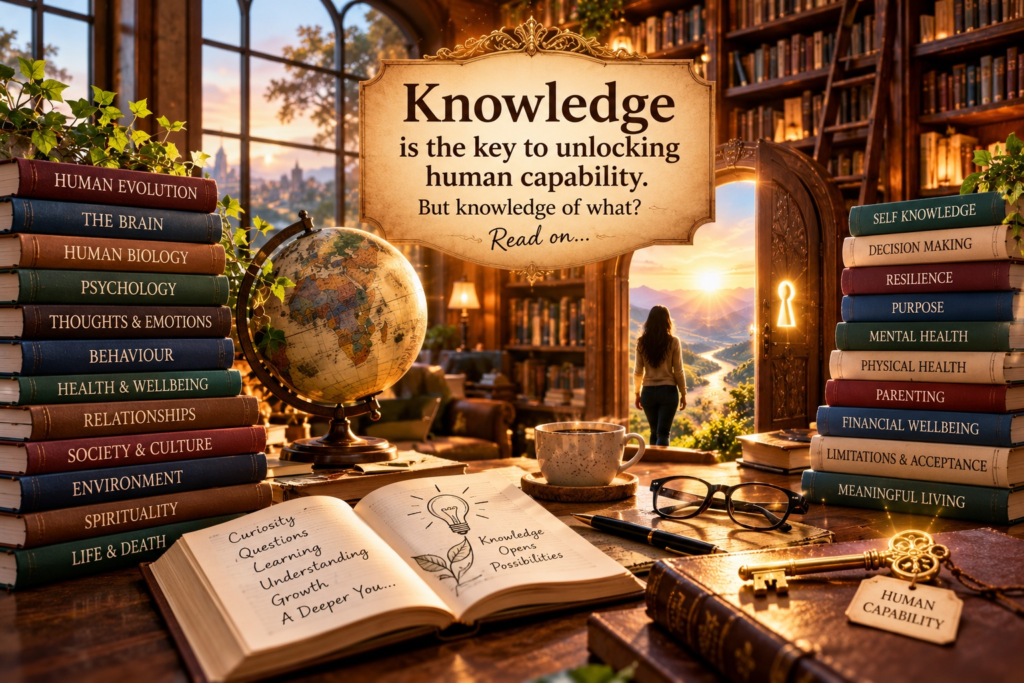
Knowledge is the key to unlocking human capability.
But knowledge of what?
Read on…
What Is Knowledge?
Knowledge is the desire and curiosity to learn, to know, and to question. It is about opening layer after layer of questions, going deeper and deeper until you reach a point where you feel there is nothing left to question—or perhaps, until another question arises.
Knowledge goes far beyond academics, degrees, or qualifications. It is not something confined to classrooms, textbooks, or universities.
Knowledge is an everyday part of life.
It is the curiosity to understand what we see, what we experience, who we are, why we think the way we think, and how the world around us works.
The moment we ask “Why?”, the journey of knowledge begins.
Lack of Knowledge and Human Suffering
Lack of knowledge is not the cause of suffering, but it can make us incapable of dealing with the problems we face.
This brings us to an important question: What kind of knowledge do we actually need?
The Knowledge of Being Human
The knowledge of who we are as a human species—how we evolved, how our bodies and brains work, and how everything within us is interconnected.
It is understanding where we came from, the changes the human brain has gone through over time, and how those changes have shaped the way we think, feel, behave, connect, fear, love, and respond to the world around us.
It is the knowledge of our biology, our brain, our emotions, our thoughts, our behaviours, and the influences of our environment and experiences.
In short, it is the knowledge of being human.
And the deeper we understand what it means to be human, the deeper we begin to understand ourselves.
What Is Capability—and What Is Incapability?
Capability is our ability to work with what is within our reach.
As human beings, we have an extraordinary capacity—the ability to think, reflect, learn, question, understand, and change our perspective.
We cannot always choose what happens to us, but we can influence how we interpret what happens and how we respond to it.
The Power of How We Think
Imagine two people experiencing the same illness.
One might think:
“I am so sick. Everything is going wrong.”
Another might think:
“Yes, I am sick right now, but I will take care of myself, seek the help I need, and deal with what comes next.”
The illness may be the same. The reality may be the same.
But their internal experience of that reality can be completely different.
This is why the way we speak to ourselves matters.
Our thoughts do not magically change every external reality, nor can positive thinking replace medical treatment. But our thoughts can influence how we experience a situation, the decisions we make, the behaviours we choose, and the way we care for ourselves.
Knowing What Is—and Is Not—in Our Hands
Then there is incapability.
There are things that simply lie outside our individual ability.
We cannot perform our own surgery merely by thinking positively. For that, we need a surgeon. We cannot control every disease, every accident, every biological process, or every event that life brings to us.
Wisdom, therefore, is also knowing the difference between what is within our capability and what is not.
If something requires medical treatment, we seek medical treatment.
If something requires knowledge, we learn.
If something requires behavioural change, we work on our behaviour.
And when something cannot be changed, we can still work on how we understand it and how we choose to live alongside it.
The Mind, the Body, and Health
Health is a beautiful example of why both knowledge and action matter.
Our thoughts alone cannot be relied upon to cure illnesses such as diabetes, cancer, or other diseases. But our psychological state, lifestyle, diet, physical activity, sleep, stress management, medical care, and regular monitoring can all become parts of how we respond to illness.
Especially when certain conditions are identified early, knowledge can give us opportunities to make changes, seek appropriate treatment, and take better care of ourselves.
So perhaps capability does not mean having the power to control everything.
Perhaps capability means knowing what we can influence, recognising what we cannot control, and having enough knowledge to respond wisely to both.
And What Is the Ultimate Limit of Human Capability?
Eventually, we arrive at the one reality that no human being can permanently change:
Death.
No amount of knowledge can make us immortal.
There may come a point in someone’s life when medicine cannot promise a cure. At that point, the question may gradually change from:
“How long can I live?”
to:
“How fully can I live the life that remains?”
And perhaps that is where knowledge reaches its deepest meaning.
Knowledge Is Not Only About Surviving
Knowledge is not only about learning how to survive.
It is about learning how to live.
To understand our body.
To understand our brain.
To understand our thoughts.
To understand our emotions.
To understand our limitations.
To understand our possibilities.
And ultimately, to understand the temporary nature of our existence.
Because when we truly understand that life is finite, ordinary moments begin to carry a different value.
The More I Know I Will Die, the More I Live
Perhaps knowing ourselves deeply does not give us control over everything.
Instead, it teaches us what deserves our effort, what requires acceptance, when we need help, and how much of our experience of life is shaped by the way we understand it.
And maybe the awareness of death does not have to take something away from life.
Maybe it can give something back.
The more deeply I know that one day I will die, the more deeply I choose to live.