
What we see outside is processed through unseen components within us, especially what we observe and sense around us, as well as what we feel.
The Nature of Thought: Is It Just Language?
We often say that language gives rise to thoughts, but what is a thought? Thoughts consist of what automatically occurs in our minds in the form of words or sentences. However, thoughts can exist even without language. You might be thinking, “But what I experience is just words in my head. My lips are silent, yet there’s still an inner voice.” This is true. It seems that it’s only words I can feel inside, even without speaking. But trust me, there is something beyond words and thoughts. Think of it as layers. In the outer layer, we talk and express ourselves. In the inner layers, we engage in internal dialogue and feel emotions. There is one layer beneath the inner layer, which we can refer to as the biological layer. We don’t typically name it with terms like cells and genes, but it is there nonetheless. It’s akin to looking beyond thoughts.
The Additive Colour Model and Brain Perception
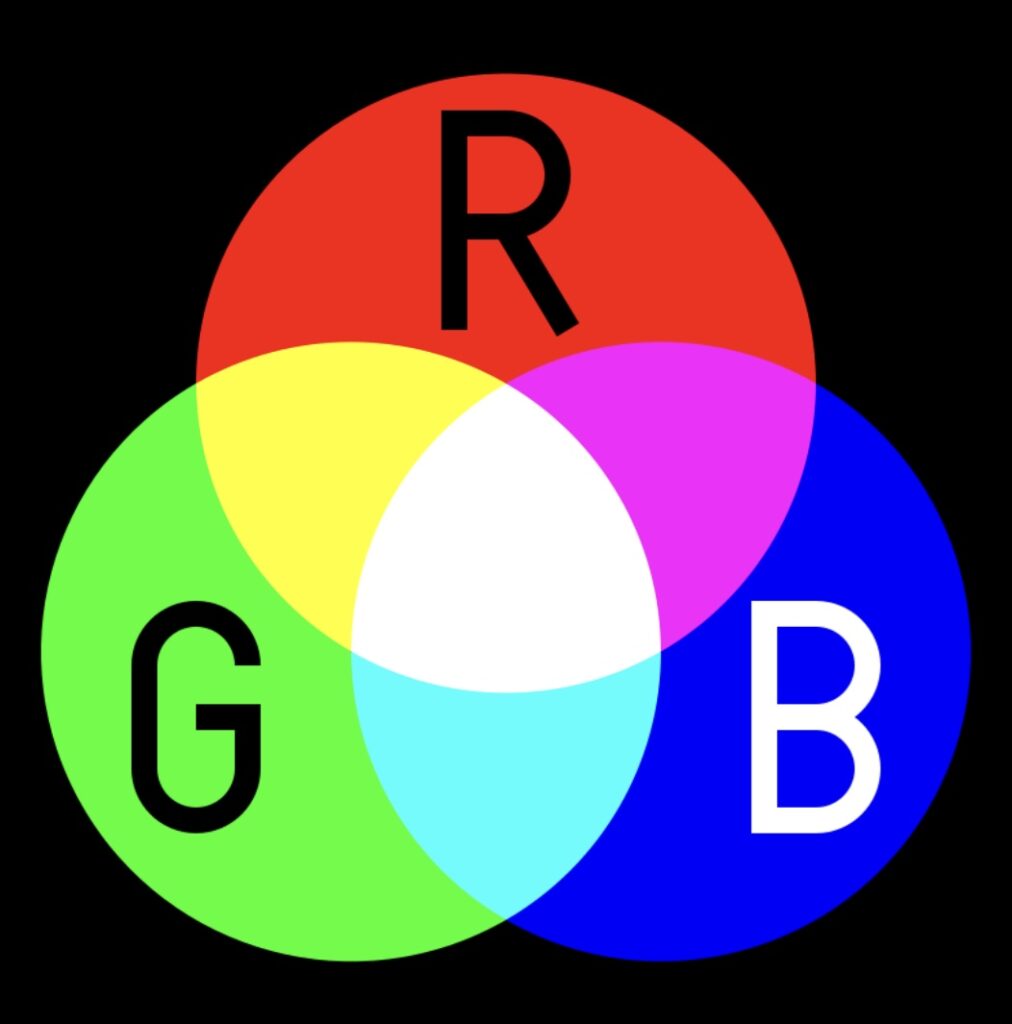
Let’s start with vision.
The cone cells in the retina and the structure of the brain are sensitive to three colours: red, green, and blue. But physically, we see multiple colours. Why?
The number of colours we perceive around us is a result of different wavelengths of light that correspond to three primary colours: red, green, and blue. This is known as the additive colour model. When we observe an object, the way these primary colours combine through the interaction of light and our perception in the brain allows us to see a vast array of colours, influenced by factors such as lighting conditions and the surface properties of the object.
We assign words to what we perceive through our eyes. Colours exist in our visual field and brain biology, even before we named them. The three colours—red, green, and blue—were present long before humans decided to call them by those names. We could have chosen to call red what we now identify as blue, and vice versa. But because the language is deeply rooted in our brains, as soon as someone mentions “red,” the colour red appears in our mind’s eye. We refer to this phenomenon as brain conditioning or neural wiring.
Even without the language for colours, perceptions of colours and their associated thoughts existed.
Spatial Awareness Without Language

Let’s go further, it is inherent in our biology to perceive things in space. For example, if I blindfold you and leave you in an unfamiliar place surrounded by objects, your sense of touch and the way you navigate will give you some idea of your surroundings. You will notice whether you bump into something, whether the object is hard or soft, or if there’s a wall nearby. Forget for a moment that these things have labels. A wall is called a “wall,” and something hard is described as “hard.” These words are names we have given to things that are tall, wide, and separate one space from another. Even if I erased the memory of the word “wall,” you would still sense that there is something there. That sensation represents a thought that exists even without a specific word.
Emotions as Pre-Linguistic Experiences

Now, let’s move even further. Let’s talk about emotions. What are emotions? Happiness, sadness, anger, jealousy, and so on are merely names given to how we feel at certain moments. For instance, imagine yourself walking in a jungle 50,000 to 60,000 years ago. In the context of this evolutionary journey, you feel something inside. You might feel hunger, but at that time, there was no word for “hunger” to describe what you were experiencing. You simply felt something. When you saw a tree and ate the fruit from it, you experienced an emotion that we today call “happiness.” Back then, you might not have understood what it was, but you felt content. Those emotional sensations existed even without words. Thus, thoughts existed even without language.
Thoughts Are Constant—And Older Than Language
Thoughts” is a profound word. Our entire lives revolve around these thoughts. As soon as we are awake, or even in dreams, there is constantly something running in our minds. We cannot truly escape it while we live. The depth of these thoughts is inherently rooted in our biology, even without language. Today, as science has advanced, we have given names to all kinds of visual perceptions, spatial awareness, and even emotions. However, the fundamental existence of these aspects remains. Using the term “thought” feels insufficient to encapsulate all of this.









Pingback: The Intersection of Science and Spirituality: Navigating Truth and Ego - Reach out to your inner self.